
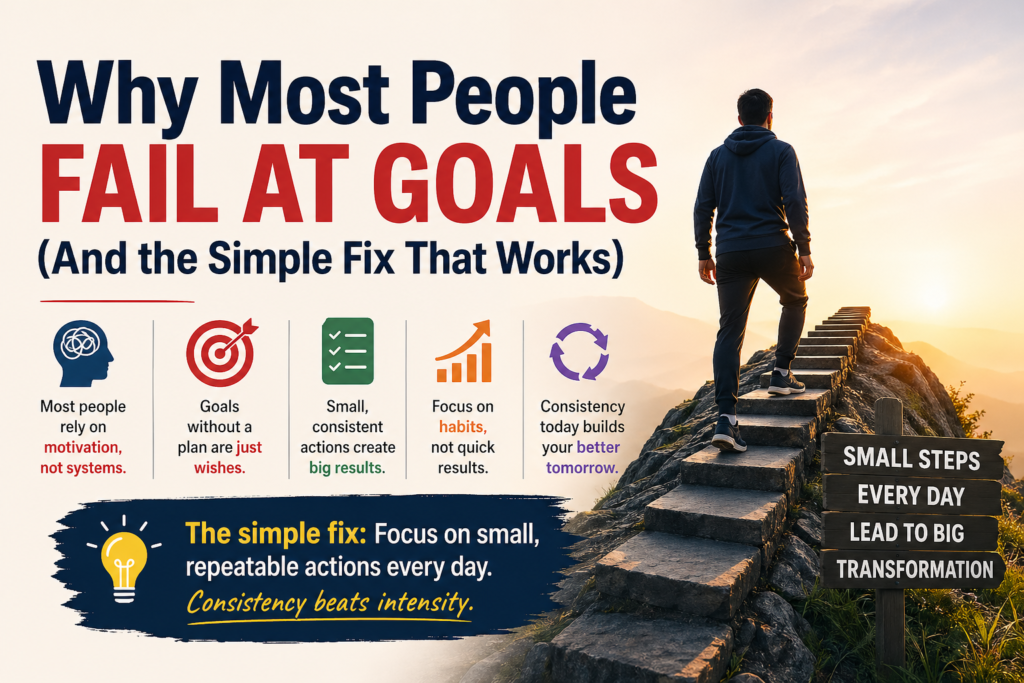
Success stories often look clean and effortless from the outside. You see the result, the fit body, the thriving business, the financial freedom but not the messy middle. What’s hidden is the truth: most people don’t fail because they lack ambition. They fail because they follow a broken approach to achieving goals.
Let’s unpack why this happens and more importantly, the simple fix that actually works.
A Familiar Story That Might Sound Like Yours
At the start of the year, Ali felt unstoppable.
He wrote down his goals with excitement. Lose 10 kg. Start an online business. Read 20 books. Wake up early every day. Everything felt possible.
For the first week, he pushed hard. Gym sessions, strict diet, late night research on making money online. Motivation was high.
Then reality stepped in.
Work got busy. Energy dropped. One missed workout turned into a skipped week. One late morning became a habit. Slowly, everything unraveled.
By February, the goals were forgotten.
Ali didn’t fail because he was lazy. He failed because his strategy was flawed, just like most people’s.
The Real Reason Most People Fail at Goals
At first glance, it seems like a motivation problem. However, the truth goes deeper.
People fail because they rely on intensity instead of consistency.
Big bursts of effort feel productive. They give the illusion of progress. Yet they’re hard to sustain.
Consistency, on the other hand, feels boring. It doesn’t give instant results. Still, it’s the only thing that actually compounds over time.
Think about it this way: doing something small every day beats doing something big once in a while.
Unfortunately, most people choose the second option.
The Motivation Myth That Keeps You Stuck
Motivation feels powerful. It pushes you to start. It makes you believe change is easy.
But motivation is unreliable.
Some days, you wake up energized. Other days, you feel drained without any clear reason. If your progress depends on how you feel, your results will always be inconsistent.
That’s where things fall apart.
Instead of chasing motivation, successful people build systems.
Because systems don’t care about your mood.
Why Goals Alone Don’t Work
Setting goals is important. They give direction. They help you visualize where you want to go.
However, goals without a process are just wishes.
Let’s say your goal is to lose weight. That sounds clear. But what happens next?
Without a daily plan, you’re left guessing. Should you exercise today? What should you eat? How much effort is enough?
This confusion leads to inaction.
Clarity removes resistance. And resistance is often the real enemy.
The Hidden Problem: Overcomplicating Everything
Another reason people fail is complexity.
They create long plans. They set unrealistic routines. They try to change everything at once.
At first, it feels exciting. Soon after, it becomes overwhelming.
When something feels too hard, your brain looks for escape.
That’s why simple plans always win.
The Simple Fix That Actually Works
Now let’s get to the part that matters.
The fix is surprisingly simple:
Focus on small, repeatable actions instead of big, overwhelming goals.
Instead of trying to transform your life overnight, commit to tiny improvements.
Not dramatic changes. Not extreme effort.
Just small actions, done daily.
What This Looks Like in Real Life
Instead of saying, “I will work out for 2 hours every day,” start with 10 minutes.
Rather than aiming to read a full book every week, read 5 pages daily.
Instead of building a full business immediately, spend 30 minutes learning or creating.
These actions may seem insignificant. Yet over time, they build momentum.
Momentum creates confidence.
Confidence builds identity.
And identity drives long-term success.
The Power of Identity Over Goals
Here’s a shift that changes everything:
Stop focusing on what you want to achieve. Start focusing on who you want to become.
Goals are external. Identity is internal.
When you say, “I want to get fit,” you’re chasing a result.
When you say, “I am someone who exercises daily,” you’re shaping your identity.
This subtle difference matters.
Because once something becomes part of who you are, it no longer feels like effort.
Why Small Wins Matter More Than Big Results
Every time you complete a small action, you prove something to yourself.
You build trust.
That trust becomes your foundation.
Without it, even the best plans fall apart.
Small wins may not look impressive. However, they create a chain reaction.
One completed task leads to another.
Progress becomes natural instead of forced.
Breaking the All or Nothing Cycle
Many people fall into a dangerous pattern.
They think, “If I can’t do it perfectly, I won’t do it at all.”
This mindset destroys progress.
Because perfection is impossible.
Instead, aim for consistency over perfection.
Missed a workout? Do a shorter one
Didn’t read today? Read one page before bed.
Progress doesn’t require perfection. It requires persistence.
The Role of Environment in Success
Willpower alone isn’t enough.
Your environment plays a bigger role than you think.
If your surroundings make bad habits easy, you’ll struggle.
If your environment supports good habits, success becomes easier.
For example:
- Keep healthy food visible
- Remove distractions from your workspace
- Set reminders for important tasks
These small adjustments reduce friction.
Less friction means more action.
Why Tracking Progress Changes Everything
What gets measured gets improved.
Tracking your actions keeps you accountable.
It also makes progress visible.
When you see your consistency, you feel motivated to continue.
Even a simple checklist can make a difference.
Each completed task becomes a small victory.
Patience: The Missing Ingredient
Most people quit too early.
They expect fast results.
When results don’t appear quickly, they assume the effort isn’t working.
That’s a mistake.
Real progress takes time.
Growth is often invisible in the beginning.
However, consistency compounds.
What feels slow today becomes powerful tomorrow.
From Frustration to Flow
At the beginning, everything feels hard.
You have to push yourself.
You have to remember your habits.
It takes effort.
Over time, something shifts.
Actions become automatic.
You stop forcing yourself.
You start flowing.
This is where real transformation happens.
The Truth Most People Avoid
There’s no shortcut.
No secret trick.
No overnight success.
The difference between those who succeed and those who don’t is simple:
They keep going when it’s boring.
They show up when they don’t feel like it.
They trust the process, even when results are invisible.
Bringing It All Together
Let’s revisit the simple fix:
Stop chasing big goals.
Start building small, consistent habits.
Focus on daily actions.
Keep things simple.
Stay patient.
That’s it.
It may not sound exciting. Still, it works.
Conclusion
Most people fail at goals not because they lack ability, but because they rely on motivation, overcomplicate their plans, and expect fast results.
A better path exists.
Small actions, repeated daily, create lasting change.
Consistency beats intensity every time.
Your future doesn’t depend on one big decision. It depends on what you do today, tomorrow and the day after that.
So instead of asking, “How can I achieve this goal quickly?”
Ask yourself something more powerful:
What small action can I repeat every single day without fail?