
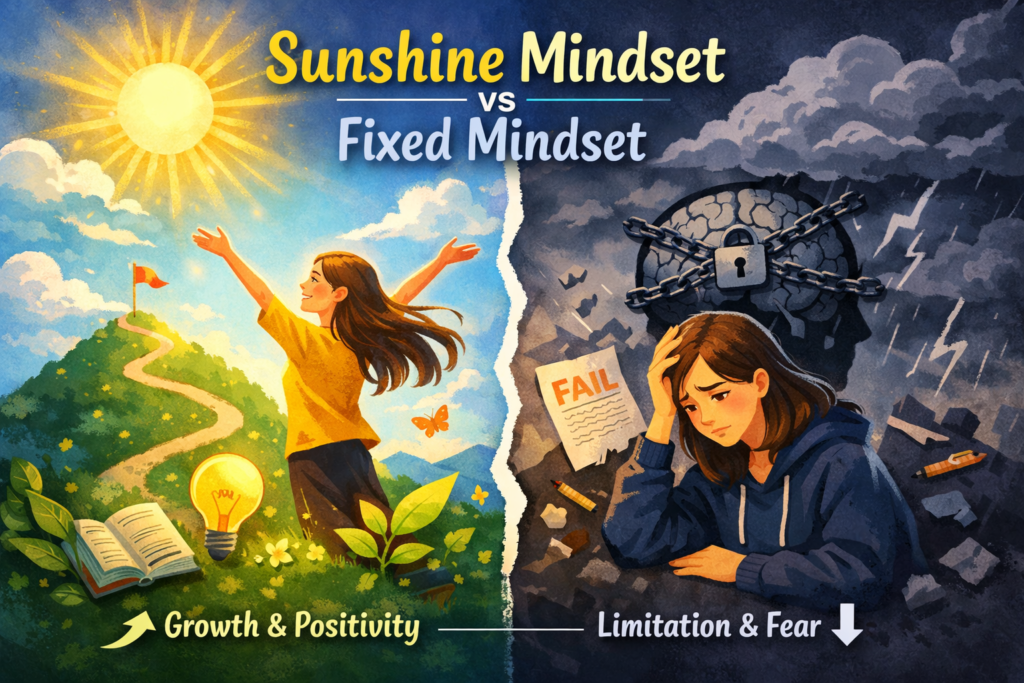
It was a quiet morning when Ayesha sat by her window, staring at the sunlight spilling across her desk. She had just failed an important exam, and her thoughts echoed, “Maybe I’m just not smart enough.” But as the warmth of the sun touched her face, another thought gently pushed through: “What if I can learn from this?” That small shift in perspective didn’t change her result but it changed her direction. That moment captures the powerful difference between a sunshine mindset and a fixed mindset.
What Is the True Mindset Meaning?
Before diving deeper, let’s understand the mindset meaning. A mindset refers to the set of beliefs and attitudes that shape how we think, feel, and respond to challenges. It influences whether we see obstacles as barriers or opportunities.
According to psychologist Carol Dweck’s research, mindsets generally fall into two main categories: fixed mindset and growth mindset (Dweck, 2006).
What Is a Fixed Mindset?
A fixed mindset is the belief that abilities, intelligence, and talents are static—you either have them or you don’t.
Key Characteristics:
- Avoids challenges
- Gives up easily
- Sees effort as pointless
- Ignores useful feedback
- Feels threatened by others’ success
People with a fixed mindset often think:
“I’m not good at this, so I never will be.”
This way of thinking can limit personal and professional growth.
What Is a Sunshine Mindset?
A sunshine mindset is a more positive, optimistic version of a growth mindset. It’s about choosing light over negativity focusing on possibilities, learning, and resilience.
It aligns closely with the idea to develop a growth mindset, where challenges are embraced and effort is seen as the path to mastery.
Key Traits:
- Sees challenges as opportunities
- Learns from criticism
- Celebrates progress, not perfection
- Maintains optimism during setbacks
- Believes improvement is always possible
Sunshine Mindset vs Fixed Mindset: Key Differences
| Aspect | Sunshine Mindset | Fixed Mindset |
|---|---|---|
| Belief about abilities | Can grow and improve | Fixed and unchangeable |
| Reaction to failure | Learns and adapts | Feels defeated |
| Effort | Essential for success | Seen as unnecessary |
| Challenges | Welcomed | Avoided |
| Success of others | Inspiring | Threatening |
Why It’s Important to Develop a Growth Mindset
When you actively work to develop a growth mindset, you open doors to continuous improvement. Research shows that individuals with growth oriented thinking are more resilient and achieve higher success over time (Dweck, 2006; Yeager & Dweck, 2012).
A sunshine mindset takes this even further by adding emotional strength and positivity, making it easier to stay motivated even during tough times.
How to Shift from Fixed to Sunshine MindsetMaking the shift doesn’t happen overnight, but small steps can create powerful change:
1. Reframe Your Thoughts
Replace “I can’t do this” with “I can learn this.”
2. Embrace Challenges
See difficulties as opportunities to grow.
3. Learn from Feedback
Constructive criticism helps improvement.
4. Celebrate Effort
Focus on progress rather than perfection.
5. Surround Yourself with Positivity
Your environment shapes your mindset more than you think.
Real-Life Impact of a Sunshine Mindset
People who adopt a sunshine mindset often experience:
- Better mental health
- Increased confidence
- Greater success in careers
- Stronger relationships
It’s not about ignoring problems, it’s about facing them with belief and resilience.
Conclusion
Understanding the true mindset meaning can transform how you approach life. A fixed mindset keeps you stuck, while choosing to develop a growth mindset especially a sunshine mindset empowers you to evolve, adapt, and thrive. Like Ayesha in the beginning, the difference lies in a single thought that shifts your path forward.
So the next time life tests you, will you stay in the shadows of limitation, or step into the light of a sunshine mindset?
References
- Dweck, C. S. (2006). Mindset: The New Psychology of Success. Random House.
- Yeager, D. S., & Dweck, C. S. (2012). Mindsets that promote resilience: When students believe that personal characteristics can be developed. Educational Psychologist, 47(4), 302–314.