
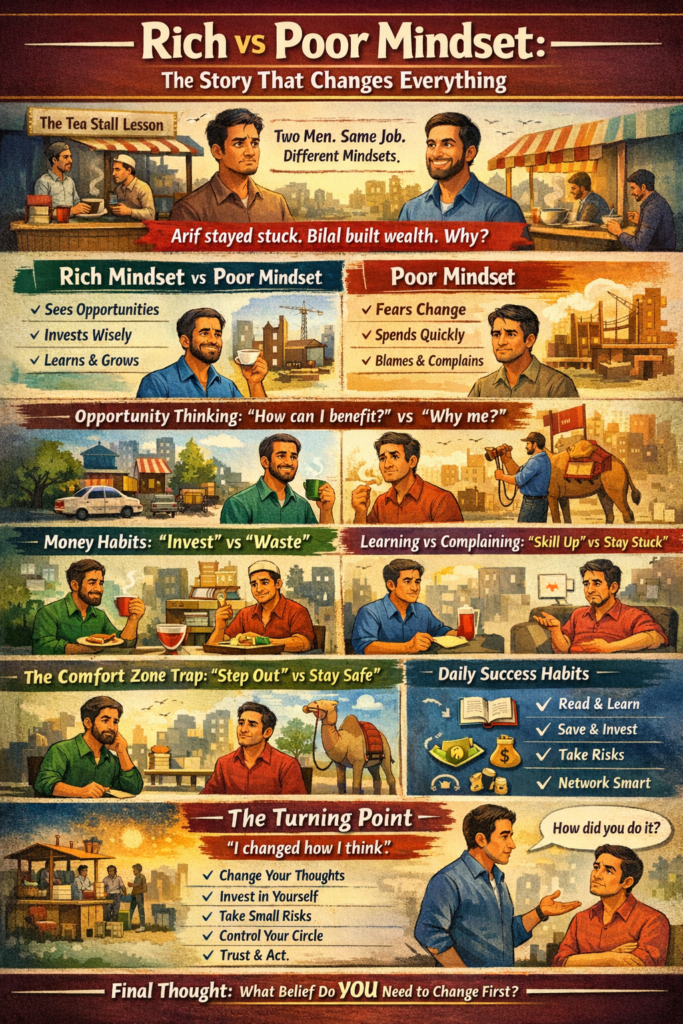
Every morning at 7:30, just before the city fully woke up, two men stood at the same roadside tea stall.
Arif arrived in a wrinkled shirt, always rushing, always tired. He complained about traffic, about money, about how “life is just unfair.”
Bilal came five minutes later. Calm. Observant. He greeted the tea seller by name. He asked questions. He listened more than he spoke.
One day, the tea seller joked, “You both earn the same salary, but you live very different lives.”
Arif laughed it off. Bilal smiled.
Three years later, Arif was still at the same job, same complaints, same struggles.
Bilal had started a small side business, invested in himself, and now owned two rental shops.
Same city. Same starting point.
Different mindset.
That’s the invisible line between a rich mindset vs poor mindset.
What Is a Rich Mindset vs Poor Mindset?
Before we go deeper, let’s make one thing clear:
A rich mindset is not about how much money you have.
A poor mindset is not about being broke.
It’s about how you think, decide, and act.
- A rich mindset focuses on growth, opportunity, and long term success
- A poor mindset focuses on survival, fear, and short term comfort
This difference quietly shapes your entire life.
The First Difference: How They See Opportunities
Back at the tea stall, a new construction project started nearby.
Arif said, “More noise, more problems.”
Bilal said, “More people, more demand.”
A week later, Bilal partnered with the tea seller to expand snacks. Sales doubled.
Rich Mindset Thinking
- Sees problems as hidden opportunities
- Asks: “How can I benefit from this?”
- Looks for solutions
Poor Mindset Thinking
- Sees problems as obstacles
- Says: “Why does this always happen to me?”
- Avoids action
The Second Difference: Relationship With Money
Arif earned money and spent it quickly.
New phone. Expensive dinners. Instant satisfaction.
Bilal earned money and asked one question:
“Will this grow my future?”
He didn’t avoid spending. He spent strategically.
Rich Mindset and Money:
- Invests before spending
- Thinks long term wealth
- Uses money as a tool
Poor Mindset and Money:
- Spends to impress
- Focuses on short term pleasure
- Sees money as something to escape problems
The Third Difference: Learning vs Complaining
One evening, Arif complained about his boss for 20 minutes.
Bilal listened quietly.
Then he said something simple:
“What skill can you learn so you don’t need that job anymore?”
That question changed nothing for Arif.
But it changed everything for Bilal.
He started learning online, marketing, communication, and business basics.
Within a year, he had a side income.
The Rich Mindset:
- Invests in learning
- Believes skills create income
- Takes responsibility
Poor Mindset:
- Blames others
- Avoids learning
- Waits for change
The Hidden Trap: Comfort Zone
Arif loved comfort.
After work, he watched videos for hours. “I need to relax,” he said.
Bilal rested too, but with intention.
He used one hour daily to build something.
A small effort, Repeated daily.
That’s how transformation really happens.
Rich Mindset:
- Delays gratification
- Builds discipline
- Steps outside comfort
Poor Mindset:
- Chooses comfort over growth
- Avoids discomfort
- Stays stuck
The Fear Factor
One day, Bilal invited Arif to join his small business.
Arif said, “What if it fails?”
Bilal replied, “What if it works?”
That’s it.
That’s the difference.
Rich Mindset:
- Takes calculated risks
- Accepts failure as learning
- Moves despite fear
Poor Mindset:
- Avoids risk
- Fears failure
- Stays in the same place
Identity: The Deepest Difference
Here’s something most people don’t realize.
Your mindset is shaped by your identity.
Arif believed:
“I am just an average person trying to survive.”
Bilal believed:
“I can grow. I can build. I can create.”
Your beliefs silently control your actions.
Rich Mindset Identity:
- “I can learn anything”
- “I create my opportunities”
- “I am responsible for my life”
Poor Mindset Identity:
- “This is just how life is”
- “I can’t change much”
- “Others control my success”
The Faith Factor (A Deeper Perspective)
Bilal often said something powerful:
“Trust in Allah, but tie your camel.”
He worked hard, but he also believed in divine support.
This balance gave him peace and courage.
Arif either worried too much or did nothing.
Rich Mindset (Faith + Action):
- Trusts in Allah
- Takes action consistently
- Believes effort is rewarded
Poor Mindset (Imbalance):
- Either no action OR no trust
- Lives in fear or laziness
This is where true strength comes from, belief + effort.
Daily Habits That Create a Rich Mindset
Bilal didn’t change overnight.
He built simple habits:
- Woke up early
- Read daily
- Saved and invested small amounts
- Learned new skills
- Networked with positive people
Small actions. Big results.
Rich Mindset Habits:
- Consistency over intensity
- Focus on growth
- Long term thinking
Poor Mindset Habits:
- Inconsistency
- Instant gratification
- Short term thinking
The Turning Point
One rainy morning, years later, Arif sat at the same tea stall.
But this time, things felt different.
He looked at Bilal, confident, calm, successful.
And for the first time, he didn’t feel jealous.
He felt curious.
“What did you really do differently?” Arif asked.
Bilal smiled and said:
“I changed how I think, before I changed what I earn.”
That sentence hit hard.
Because it was true.
Why Most People Stay Stuck
It’s not because they lack talent.
It’s not because they lack opportunity.
It’s because they don’t change their mindset.
They wait.
They delay.
They doubt.
And slowly, they settle.
How to Shift From Poor Mindset to Rich Mindset
You don’t need money to start.
You need awareness.
Start here:
- Change your thoughts
Notice negative patterns and replace them - Invest in yourself
Skills pay more than time - Take small risks
Growth requires movement - Control your environment
Surround yourself with growth thinkers - Trust and act
Faith without action is incomplete
Conclusion: The Real Wealth.
The difference between a rich life and a poor life is not your bank balance.
It’s your mindset.
Arif and Bilal started at the same place.
But one stayed stuck.
The other grew.
Because one focused on problems, and the other focused on possibilities.
Final Thought
If nothing changes in your life right now,
What is the one belief you need to change first?