
The Day Everything Felt Out of Control
Three years ago, Adam looked successful from the outside.
His calendar stayed packed. Notifications never stopped buzzing. Every hour carried another task, another email, another urgent message. People called him hardworking.
Still, something felt wrong.
Despite working twelve-hour days, he constantly ended the night with unfinished goals. Stress followed him everywhere. Even weekends felt heavy.
One Tuesday morning changed everything.
Adam arrived early for a meeting with a senior executive at his company. Expecting another lecture about performance, he prepared excuses in his head.
Instead, the executive asked one simple question.
“Why are you doing so much that doesn’t matter?”
That sentence stayed with him.
Over the next few months, Adam began studying how highly productive people actually work. Surprisingly, the best performers were not hustling nonstop.
They used systems.
Small hidden productivity hacks shaped their days. Tiny decisions protected their energy. Invisible habits created massive results over time.
Today, those same strategies help entrepreneurs, students, creators, and professionals get more done without burnout.
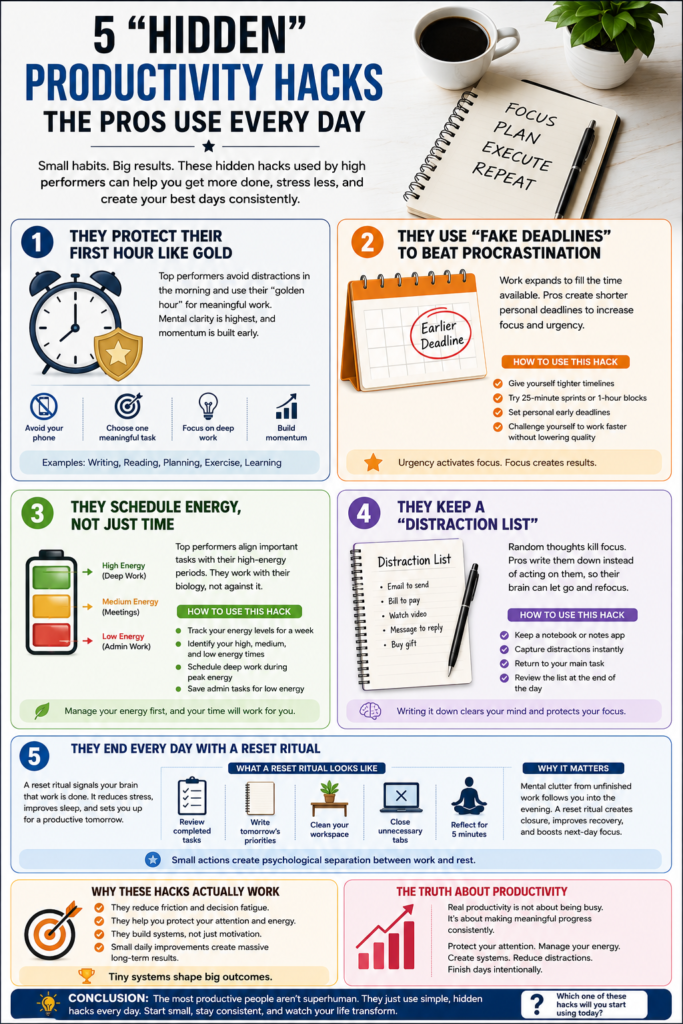
Here are five powerful productivity hacks successful people quietly use every single day.
1. They Protect Their First Hour Like Gold
Most people start mornings reactively.
They open social media. Check emails. Scroll through notifications. Respond to messages before their brain even fully wakes up.
That habit destroys focus before the day begins.
Top performers do the opposite.
They protect the first hour of the day from distractions.
This period is often called your “golden hour.” Mental clarity reaches its peak during this time. Energy levels remain high. Decision fatigue has not started yet.
Successful people use this window for meaningful work instead of consumption.
Writers write.
Athletes train.
Business owners plan.
Creators create.
The difference seems small, but it changes everything.
Research in cognitive psychology shows that attention weakens throughout the day as decisions accumulate. Early hours often produce the highest-quality thinking.
A focused first hour creates momentum that carries into the afternoon.
How to Use This Hack
Start simple.
Avoid touching your phone for the first 30 minutes after waking up.
Choose one meaningful task before checking notifications.
Examples include:
- Writing
- Reading
- Planning
- Deep work
- Exercise
- Meditation
- Learning a skill
This single habit improves mental clarity, time management, and daily productivity.
2. They Use “Fake Deadlines” to Beat Procrastination
Most people work slowly when time feels unlimited.
A task that could take thirty minutes somehow stretches into three hours.
Professionals understand an important truth:
Work expands to fill the time available.
This idea is known as Parkinson’s Law.
Highly productive people create shorter personal deadlines before the real deadline arrives.
That pressure increases focus instantly.
Imagine you need to finish a report by Friday.
Instead of aiming for Friday evening, a productive person sets a personal deadline for Thursday morning.
Now the brain shifts into action mode earlier.
Momentum appears faster.
Perfectionism decreases.
Distractions lose power.
This technique works because urgency activates concentration.
How to Use This Hack
Give yourself tighter timelines.
Try using:
- 25-minute focus sprints
- One-hour project blocks
- Self-imposed early deadlines
You can even turn work into a game.
Challenge yourself:
“How fast can I complete this without lowering quality?”
That question alone boosts efficiency.
3. They Schedule Energy, Not Just Time
Most productivity advice focuses only on managing hours.
Professionals think differently.
They manage energy first.
Every person experiences natural peaks and crashes throughout the day. Some people think best in the morning. Others become creative at night.
High performers align important tasks with high-energy periods.
This hidden productivity secret dramatically improves output.
For example:
- Deep thinking happens during peak energy
- Meetings happen during average energy
- Easy admin work happens during low energy
That structure prevents mental exhaustion.
Instead of fighting biology, productive people work with it.
The Mistake Most People Make
Many people waste peak mental hours on emails and social media.
Later, when important work finally begins, their brain already feels tired.
That creates frustration and procrastination.
Energy-aware scheduling fixes this problem.
How to Use This Hack
Track your focus levels for one week.
Notice:
- When you feel mentally sharp
- When motivation drops
- When distractions increase
Then reorganize your schedule around those patterns.
This strategy improves focus, productivity, and work-life balance naturally.
4. They Keep a “Distraction List”
Distractions rarely disappear.
Even during focused work, random thoughts appear constantly.
You suddenly remember:
- An email to send
- A bill to pay
- A video to watch
- A message to answer
Most people immediately stop working to handle these thoughts.
That destroys concentration.
Professionals use a hidden trick called a distraction list.
Whenever unrelated thoughts appear, they quickly write them down instead of acting on them immediately.
The brain relaxes because it knows the thought will not be forgotten.
Focus returns faster.
This technique sounds incredibly simple, yet it works powerfully.
Studies on attention show that unfinished thoughts occupy mental space. Writing them down reduces cognitive load.
How to Use This Hack
Keep:
- A notebook
- Sticky notes
- A notes app
- A small whiteboard
Every time a distraction appears, capture it instantly.
Then return to your main task.
At the end of the day, review the list.
This method strengthens deep work habits and reduces multitasking.
5. They End Every Day With a Reset Ritual
Most people end work abruptly.
One minute they are answering emails.
Next minute they are lying in bed scrolling endlessly.
Their brain never receives closure.
Professionals use reset rituals to mentally shut down the workday.
This hidden productivity habit reduces stress and improves next-day performance.
A reset ritual can take only ten minutes.
The goal is simple:
Signal to your brain that work is finished.
That prevents mental clutter from carrying into the evening.
What a Reset Ritual Looks Like
A professional might:
- Review completed tasks
- Write tomorrow’s priorities
- Clean their workspace
- Close unnecessary tabs
- Reflect for five minutes
Small actions create psychological separation between work and rest.
This improves sleep, recovery, and focus the next day.
Why This Matters
Burnout often comes from mental overload, not just long hours.
When your brain never disconnects, productivity eventually collapses.
Reset rituals protect long-term performance.
Why These Productivity Hacks Actually Work
Most people search for motivation.
Professionals build systems.
That difference changes everything.
Hidden productivity hacks succeed because they reduce friction.
Instead of relying on willpower every moment, these habits make focus easier and distractions harder.
Small daily improvements create massive long-term results.
One protected hour each morning may not seem life-changing today.
Still, over months, it can transform your career, finances, confidence, and mental clarity.
Tiny systems shape big outcomes.
The Truth About Productivity Nobody Talks About
Real productivity is not about being busy.
It is about making meaningful progress consistently.
Many people chase complicated apps, expensive planners, and endless productivity tools.
Yet the most effective strategies are usually simple.
Protect your attention.
Manage your energy.
Create systems.
Reduce distractions.
Finish days intentionally.
That is what successful people quietly do every day.
Conclusion
The most productive people are not superhuman.
They simply understand how to work smarter instead of harder.
These hidden productivity hacks may look small at first glance, but their impact grows daily.
Protecting your mornings can sharpen focus.
Creating fake deadlines can destroy procrastination.
Managing energy instead of just time can boost efficiency.
Writing distractions down can strengthen concentration.
Ending each day with a reset ritual can prevent burnout.
Success rarely comes from one giant breakthrough.
Usually, it grows from small habits repeated consistently.
So here is the real question:
Which one of these productivity hacks will you start using today?