
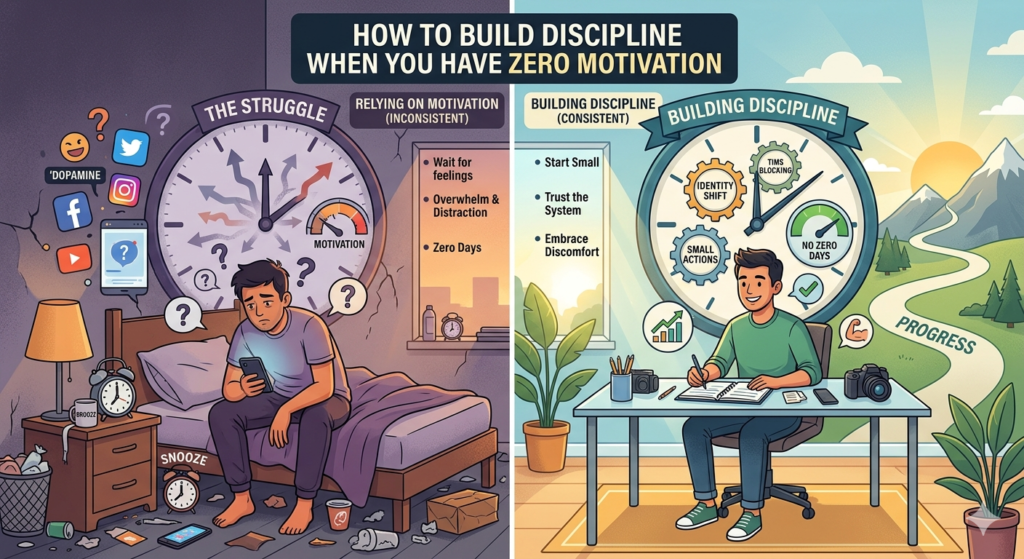
Ali used to wake up every day with the same plan and the same failure.
He wanted to change his life. He dreamed about making money online, building confidence, and escaping the cycle of procrastination. Still, every morning felt heavy. His alarm rang, he hit snooze, and motivation disappeared before the day even began.
Hours slipped away on his phone. By night, guilt replaced ambition.
He kept asking himself one question:
“Why can’t I just stay disciplined?”
If you’ve ever felt the same way, you’re not alone. In fact, most people struggle not because they lack goals but because they rely on motivation to achieve them.
That’s where everything goes wrong.
The Reality of Motivation (And Why It Fails You)
Motivation feels powerful in the moment.
It pushes you to start something new. It gives you energy for a day or two. Sometimes, it even convinces you that this time will be different.
However, motivation doesn’t last.
Some mornings you feel excited. Other days, even simple tasks feel impossible. This inconsistency happens because motivation depends on emotions, and emotions constantly change.
Discipline, on the other hand, works differently.
Discipline shows up even when you don’t feel like it.
That’s why successful people don’t wait for motivation. Instead, they build habits that force action regardless of how they feel.
Why You Have Zero Motivation Right Now
Before fixing the problem, it helps to understand what’s causing it.
Lack of motivation is rarely about laziness. More often, it comes from deeper issues that quietly drain your energy.
For example, overwhelm can make even small tasks feel huge. When your brain sees too much to do, it shuts down.
At the same time, unclear goals create confusion. If you don’t know exactly what to do, you delay starting.
Fear also plays a role. Fear of failure, judgment, or even success can stop you before you begin.
Then there’s distraction. Social media, instant entertainment, and constant notifications train your brain to seek easy dopamine instead of meaningful work.
Because of these factors, your mind chooses comfort over progress.
The good news is that discipline can override all of this.
The Identity Shift That Changes Everything
Ali tried forcing himself to work harder.
He made schedules, watched motivational videos, and promised to “start tomorrow.” None of it lasted.
Eventually, he realized something important.
He was focusing on actions without changing his identity.
So he made a simple shift:
Instead of saying, “I need to be disciplined,” he started saying, “I am a disciplined person.”
At first, it felt strange. Even fake.
Still, he backed it up with small actions.
He showed up for five minutes. Then ten. Then more.
Over time, those actions reinforced his new identity.
That’s how discipline truly begins not with effort, but with belief.
Start Smaller Than You Think
Most people fail because they start too big.
They try to completely transform their lives overnight. They create intense routines, unrealistic goals, and strict schedules.
That approach leads to burnout.
Instead, start so small that failure feels impossible.
Work for five minutes. Read one page. Do one push-up.
These actions seem insignificant, but they build consistency.
Once consistency is established, growth becomes natural.
Small actions repeated daily create powerful results over time.
The “No Zero Days” Rule
One simple rule can change everything:
Never have a zero day.
That means you do something no matter how small, every single day.
Even on your worst days, you take one step forward.
This removes pressure while maintaining momentum.
Ali used this rule when he felt completely unmotivated. Some days, he only worked for a few minutes.
However, those minutes kept his habit alive.
Eventually, those small efforts turned into long, productive sessions.
Consistency always beats perfection.
Build Systems Instead of Relying on Willpower
Willpower is unreliable.
It fades when you’re tired, stressed, or distracted.
That’s why discipline shouldn’t depend on it.
Instead, create systems that make action automatic.
For instance, prepare your workspace the night before. Set a fixed time for important tasks. Remove unnecessary decisions from your day.
When your environment supports your goals, discipline becomes easier.
You don’t have to think, you just follow the system.
Eliminate Distractions That Kill Focus
Discipline becomes difficult in a distracted environment.
Every notification, message, and scroll breaks your focus.
Over time, your brain becomes addicted to quick rewards.
Because of that, deep work feels harder.
The solution is to remove distractions aggressively.
Turn off notifications. Keep your phone in another room. Use apps that block social media during work hours.
When distractions disappear, focus improves naturally.
And with better focus, discipline becomes effortless
Focus on the Process, Not the Outcome
One of the biggest mistakes people make is expecting quick results.
When progress feels slow, motivation drops.
That’s when most people quit.
Instead, shift your focus to the process.
Show up every day. Do the work. Trust the system.
Results take time, but consistency guarantees them.
Ali stopped worrying about outcomes. He focused only on completing his daily tasks.
Over time, results started showing up without pressure.
Use Time Blocking to Stay Consistent
Unplanned days lead to wasted time.
When you don’t decide in advance, your brain defaults to comfort.
Time blocking solves this problem.
Plan your day into specific blocks of focused work.
For example:
Morning can be for deep work. Afternoon for lighter tasks. Evening for reflection and planning.
This structure removes decision fatigue.
You don’t wonder what to do, you already know.
That clarity builds discipline.
Make Discipline Easier Than Quitting
At one point, Ali realized quitting felt easier than continuing.
So he changed the system.
He made discipline easier and quitting harder.
He tracked his progress daily, shared his goals publicly and rewarded himself for consistency.
At the same time, he simplified his tasks.
Clear steps. Small actions. No confusion.
This shift made it easier to stay consistent than to give up.
Track Your Progress Every Day
Tracking creates awareness.
It shows you whether you’re improving or staying stuck.
More importantly, it builds accountability.
Use a habit tracker or simple checklist.
Mark every day you stay consistent.
Over time, you’ll build a streak.
That streak becomes powerful motivation.
You won’t want to break it.
Learn to Embrace Discomfort
Discipline is uncomfortable.
There’s no way around it.
Your brain prefers comfort, so it resists effort.
However, discomfort is a sign of growth.
Every time you act despite resistance, you get stronger.
Instead of avoiding discomfort, accept it.
Train yourself to move forward anyway.
That’s where real progress happens.
Create a Simple Daily Routine
A routine removes uncertainty.
Instead of deciding what to do each day, you follow a plan.
This reduces mental effort and increases consistency.
Start with a simple structure.
Wake up at the same time. Begin with one productive task. Schedule focused work periods. End the day with reflection.
This routine builds discipline automatically.
Stop Waiting for the Perfect Moment
Waiting feels safe.
You tell yourself you’ll start when you feel ready, confident, or motivated.
That moment rarely comes.
Action creates readiness not the other way around.
Start before you feel ready.
Even imperfect action moves you forward.
Progress always beats delay.
The Transformation
Weeks passed, and something changed for Ali.
He didn’t suddenly feel motivated.
Instead, he became consistent.
He showed up every day, no matter how he felt.
Slowly, discipline replaced procrastination.
His confidence grew, focus improved and results followed.
The biggest change wasn’t external.
It was internal.
He became the kind of person who takes action.
Final Thoughts
Building discipline when you have zero motivation is not about forcing energy.
It’s about creating systems, habits, and identity shifts that make action inevitable.
Start small. Stay consistent. Remove distractions. Focus on the process.
Over time, discipline becomes part of who you are.
Once that happens, success stops feeling difficult.
It becomes natural.
Conclusion
Motivation is temporary, but discipline is permanent.
When you stop depending on feelings and start building habits, everything begins to change.
Your productivity improves, confidence grows and your life moves forward.
So don’t wait for motivation.
Take one small step today.
Because the real question is:
Are you ready to act even when you don’t feel like it?