
The Night I Almost Quit
Rain tapped against the apartment window while I stared at my laptop screen in frustration.
Another late night.
Another week with disappointing numbers.
My side hustle had been running for almost a year, yet the income barely moved. Some months looked promising. Others felt painfully slow.
The worst part wasn’t the money.
Exhaustion hit harder than financial stress.
I worked a full-time job during the day, then spent nights trying to grow an online business that felt stuck in the same place.
Coffee cups piled beside my desk.
Unread emails filled my inbox.
Motivation slowly disappeared.
At one point, I seriously considered quitting.
Then something unexpected happened.
A client sent me a short message after I delivered a project early.
“You’re one of the few freelancers who actually communicates properly.”
That sentence stayed in my mind longer than expected.
Because suddenly, I realized something important.
Most people weren’t failing because they lacked talent.
They were failing because they lacked systems.
That night changed everything.
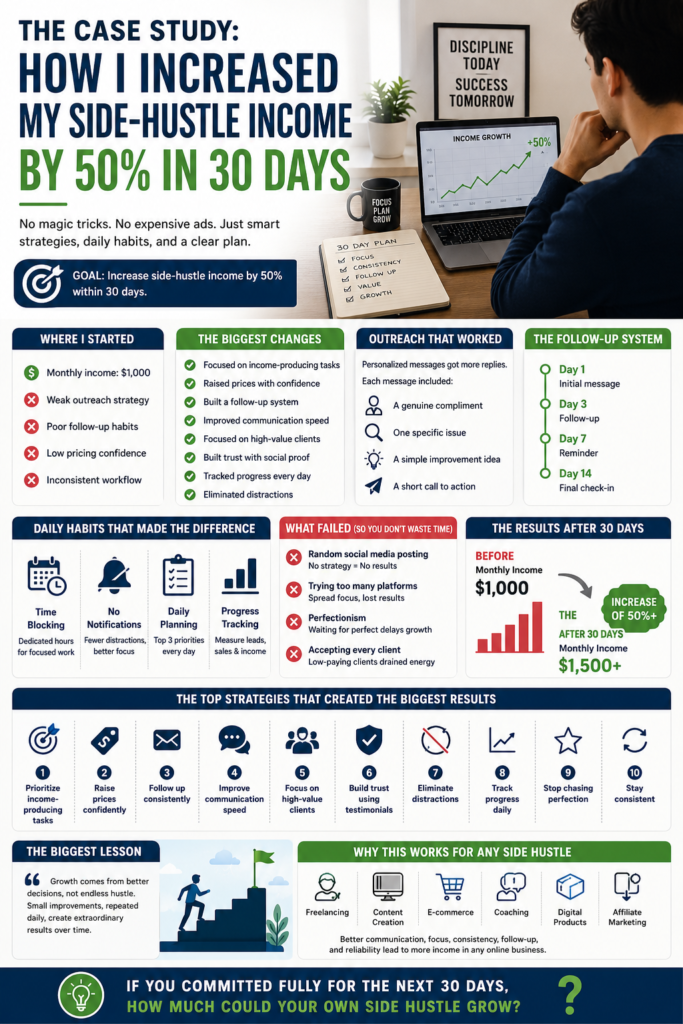
Instead of working harder, I decided to approach my side hustle like a real business for the next 30 days.
The challenge was simple:
Increase my side hustle income by 50% within one month.
No magic tricks, expensive ads.
And no viral luck.
Just smarter decisions.
Surprisingly, the experiment worked far better than expected.
This is the exact case study of what happened.
Where My Side Hustle Started
Before the 30-day experiment, my side hustle generated around $1,000 per month.
Income came mostly from freelance online services.
Some clients arrived through referrals.
Others found me through social media.
Consistency, however, was missing.
Several major problems became obvious after reviewing my business honestly.
- Weak client outreach
- Poor pricing strategy
- No follow-up system
- Inconsistent marketing
- Too many distractions
- Low productivity habits
Another issue hurt growth badly.
I spent too much time looking busy instead of doing work that actually produced income.
Researching logos.
Watching endless business videos.
Checking analytics every hour.
Scrolling through competitors.
None of those activities directly increased revenue.
That realization became the foundation of everything that followed.
The First Big Change: Tracking Every Hour
During Day 1, I wrote down every single task I completed.
The results shocked me.
Nearly half my working hours disappeared into low value activities.
Productive work only happened in short bursts.
Distractions controlled the schedule.
So I made one important rule.
Every task had to answer this question:
“Does this activity help generate income?”
If the answer was no, it became secondary.
That simple filter changed my workflow immediately.
Mornings became dedicated to high income tasks only.
Client outreach came first.
Follow ups came second.
Project delivery stayed third.
Everything else happened later.
Focus improved almost instantly.
Within a few days, more conversations with potential clients started happening.
Momentum slowly returned.
Why Most Side Hustles Stay Stuck
Many people believe side hustle success depends on motivation.
Reality looks different.
Systems matter more than temporary inspiration.
Motivation disappears quickly after stressful days.
Discipline survives longer.
Another major problem affects online businesses today.
Too many creators consume information endlessly without implementing anything.
Watching productivity content feels productive.
Unfortunately, consumption rarely creates income.
Execution does.
That lesson became painfully clear during the first week.
Once I reduced distractions, results improved faster than expected.
The 80/20 Rule Changed Everything
One productivity principle completely transformed my approach.
The Pareto Principle states that 80% of results usually come from 20% of efforts.
After reviewing previous clients, patterns became obvious.
A small number of customers generated most of my revenue.
Those clients paid faster.
Communication stayed easier.
Repeat orders happened more often.
Meanwhile, low-paying clients consumed massive amounts of time and energy.
So I made a difficult decision.
Cheap projects had to go.
Instead of accepting every opportunity, I focused only on high-value work.
That shift improved income and reduced stress simultaneously.
Quality replaced quantity.
Better clients began appearing almost immediately.
Raising My Prices Felt Terrifying
Week 2 introduced the scariest change of the experiment.
I increased my prices by 30%.
Fear appeared instantly.
Thoughts raced through my head.
“What if clients disappear?” or nobody hires me?”
“And what if I lose everything?”
Still, I moved forward anyway.
Something surprising happened next.
Higher quality clients started responding more seriously.
Negotiations became shorter.
Respect increased during conversations.
Several people hired me without questioning the pricing.
One client even said:
“You should probably charge more.”
That sentence completely changed my mindset.
Cheap pricing often attracts difficult customers.
Premium pricing attracts people who value results.
Confidence matters deeply in business.
When you undervalue yourself, clients usually notice.
Once pricing improved, my income started rising faster than expected.
The Exact Outreach Strategy That Brought Clients
Cold outreach used to feel awkward.
Most messages sounded robotic and desperate.
Replies rarely came.
Then I changed the structure completely.
Instead of generic sales pitches, each message became personalized.
Every outreach message included:
- A genuine compliment
- One specific issue I noticed
- A simple improvement idea
- A short call to action
Here’s an example:
“Hi, I really like how your brand communicates with customers. I noticed your website loads slowly on mobile devices, which could affect conversions. I specialize in improving user experience and would love to share a few ideas if interested.”
Simple.
Direct.
Personal.
That strategy worked far better than long sales paragraphs.
People respond when they feel understood.
Generic copy and paste messages rarely build trust.
Within two weeks, several new clients came directly from outreach.
That became one of the biggest reasons behind the income increase.
The Follow Up System Increased Conversions
Most people quit too early.
That truth became obvious during Week 3.
Previously, I contacted leads once and never followed up again.
Huge mistake.
Potential clients are busy.
Messages get buried.
Emails get forgotten.
Timing matters.
So I created a simple follow up system.
Nothing complicated.
Every lead received:
- Initial message
- Follow up after 3 days
- Reminder after 7 days
- Final check in after 14 days
The results surprised me immediately.
Nearly 40% of positive responses came from follow ups.
One client admitted they forgot to reply earlier.
Another said the persistence showed professionalism.
Consistency often wins where talent fails.
Most opportunities disappear because people stop too soon.
Social Proof Became a Game Changer
Another weakness became obvious during the experiment.
Potential clients wanted proof.
Promises alone no longer worked online.
People needed evidence before trusting someone.
So I improved my portfolio.
Testimonials became more visible.
Results replaced vague claims.
Instead of writing:
“I help businesses grow” , changed the wording to: “I helped a small online store increase engagement by 42% in 60 days.”
Specific numbers create trust.
Clear outcomes build authority.
Case studies feel more believable than generic statements.
After updating my profiles and portfolio, conversion rates improved noticeably.
Potential clients asked fewer skeptical questions.
Calls became smoother.
Trust increased before conversations even started.
Speed Created a Competitive Advantage
Week 4 introduced another powerful strategy.
I decided to become faster than competitors.
Most freelancers move slowly.
Replies take hours.
Projects drag endlessly.
Communication feels inconsistent.
I wanted clients to feel relief when working with me.
So I improved response times dramatically.
Messages received replies quickly.
Projects were delivered earlier than expected.
Progress updates became frequent.
Clients noticed immediately.
One customer said:
“You’re the easiest freelancer I’ve worked with.”
That client later referred two additional customers.
Reliability creates repeat business.
Fast communication builds trust faster than fancy marketing.
Businesses love working with people who reduce stress instead of creating it.
The Daily Habits That Increased Productivity
Success during those 30 days didn’t come from motivation alone.
Several daily habits created consistency.
1. Time Blocking
Specific hours became dedicated to focused work.
Outreach happened during mornings.
Client work happened during afternoons.
Learning happened during evenings.
That structure eliminated confusion.
2. Phone Notifications Stayed Off
Distractions destroy momentum.
Turning off notifications improved concentration immediately.
Deep work sessions became easier.
3. Daily Planning
Every night, I wrote down the top three priorities for the next day.
Decision fatigue disappeared.
Clarity improved productivity.
4. Progress Tracking
I measured:
- Leads contacted
- Responses received
- Sales closed
- Revenue generated
Tracking created awareness.
Awareness improved decision-making.
What Failed Completely
Not every strategy worked.
Several ideas wasted time.
That part matters because many success stories hide mistakes.
Here’s what failed during the experiment.
Random Social Media Posting
Posting without strategy produced almost no income growth.
Views alone mean very little.
Content must support business goals.
Trying Too Many Platforms
Managing five platforms at once destroyed focus.
Eventually, I concentrated only on channels producing actual leads.
Results improved quickly afterward.
Perfectionism
Waiting for everything to become perfect delayed action.
Progress matters more than perfection in business.
Speed creates momentum.
Accepting Every Client
Difficult clients consumed too much energy.
Learning to say no became essential for growth.
The Numbers After 30 Days
At the end of the experiment, the results looked like this:
Before
- Monthly income: $1,000
- Weak outreach strategy
- Poor follow-up habits
- Low pricing confidence
- Inconsistent workflow
After 30 Days
- Monthly income: $1,500+
- Better-quality clients
- More referrals
- Stronger confidence
- Faster communication
- Improved systems
The side hustle income increased by over 50%.
Even more importantly, stress levels dropped.
Work felt organized instead of chaotic.
The business finally seemed sustainable.
The Biggest Lesson I Learned
The most valuable lesson had nothing to do with money.
Growth usually comes from better decisions, not endless hustle.
Many side hustlers think they need more hours.
Often, they simply need better systems.
Small improvements compound over time.
One stronger habit leads to another.
Confidence grows gradually.
Momentum builds quietly.
Results eventually follow.
Success rarely happens overnight.
Consistency creates transformation slowly.
Why This Strategy Works for Almost Any Side Hustle
The interesting part about this experiment is that the lessons apply to nearly every online business.
Freelancing.
Content creation.
E-commerce.
Coaching.
Digital products.
Affiliate marketing.
Almost every side hustle grows faster when these fundamentals improve:
- Communication
- Focus
- Consistency
- Follow-up
- Positioning
- Confidence
- Reliability
None of those skills require luck.
Every single one can be developed.
That should encourage anyone feeling stuck right now.
The Exact Changes That Produced the Biggest Results
If I had to summarize the most effective strategies, they would be these:
- Prioritize income-producing tasks
- Raise prices confidently
- Follow up consistently
- Improve communication speed
- Focus on high-value clients
- Build trust using testimonials
- Eliminate distractions
- Track progress daily
- Stop chasing perfection
- Stay consistent even without motivation
Simple changes created massive improvements.
Final Thoughts
Thirty days will not turn someone into an overnight millionaire.
That isn’t realistic.
Still, one focused month can completely change the direction of a side hustle.
The biggest transformation happened mentally.
I stopped treating the business like a hobby.
Instead, I approached it like a serious opportunity.
That mindset changed my actions.
Those actions changed the results.
Many people already possess valuable skills capable of generating extra income online.
What they often lack is structure, consistency, and focus.
The good news?
Those qualities can be learned.
Real growth usually comes from small improvements repeated daily.
One better decision.
One stronger habit.
One extra follow-up.
One focused hour.
Over time, those tiny actions create extraordinary outcomes.
So here’s the question:
If you committed fully for the next 30 days, how much could your own side hustle grow?