
You tell yourself you’ll start tomorrow.
You promise this time will be different.
Yet somehow, nothing changes.
The cycle repeats so often that a quiet label begins to stick lazy. It feels like the easiest explanation. After all, if you’re not moving forward, you must be unwilling to try.
But that belief misses the truth.
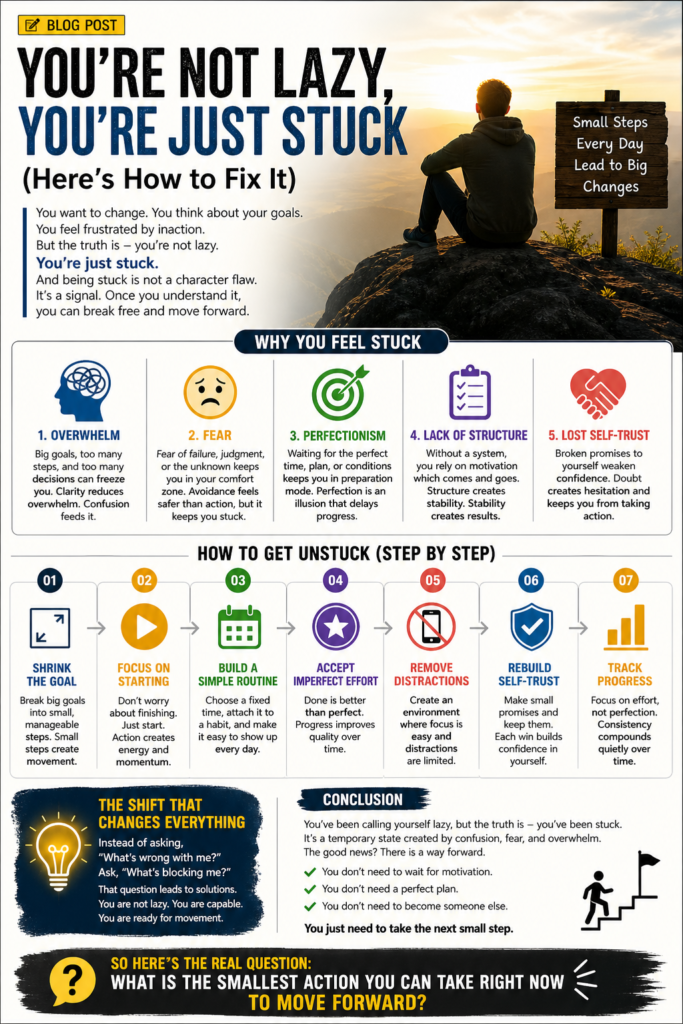
You’re not lazy. You’re stuck.
And being stuck is not a character flaw. It’s a signal. Something deeper is holding you in place, and once you understand it, progress becomes possible again.
The Lie of Laziness
Laziness is often misunderstood. It suggests a lack of desire, a refusal to act, or a comfort with doing nothing.
Yet look closely at your own experience.
You think about your goals.
You feel frustrated by inaction.
You wish things were different.
That’s not laziness. That’s tension.
Real laziness feels neutral. Being stuck feels heavy.
The guilt, the overthinking, the constant restarting, these are not signs of someone who doesn’t care. They are signs of someone who cares deeply but doesn’t know how to move forward.
What Being Stuck Really Looks Like
Being stuck rarely appears obvious. It hides behind behaviors that seem harmless on the surface.
You scroll instead of starting.
You plan endlessly but never act.
You wait for motivation that never arrives.
You begin something, then quickly lose momentum.
Each moment feels small. Together, they build a pattern.
This pattern is not random. It has roots.
Understanding those roots is the first step to breaking free.
The Real Reasons You Feel Stuck
1. Overwhelm Is Freezing You
Big goals can feel exciting at first. Then reality sets in.
There are too many steps.
There are too many unknowns.
There are too many decisions.
Your brain reacts by shutting down.
Instead of taking action, you delay. Not because you don’t want to act, but because the path feels too heavy to carry.
Clarity reduces overwhelm. Confusion feeds it.
2. Fear Is Quietly Controlling You
Fear doesn’t always scream. Sometimes it whispers.
“What if you fail?”
“What if you embarrass yourself?”
“What if it doesn’t work?”
So you hesitate.
Avoidance feels safer than action. Staying where you are feels less risky than stepping into uncertainty.
Ironically, this fear disguises itself as procrastination.
3. Perfectionism Is Slowing You Down
You don’t want to start until everything is right.
The plan must be perfect.
The timing must be ideal.
The conditions must feel aligned.
So you wait.
But perfection is not a starting point. It’s an illusion that keeps you trapped in preparation mode.
Progress begins with imperfection.
4. Lack of Structure Is Holding You Back
Motivation is unreliable. It comes and goes.
Without a clear system, your actions depend on how you feel in the moment.
Some days you’re inspired. Most days you’re not.
Consistency cannot survive in a system built on emotion alone.
Structure creates stability. Stability creates results.
5. You’ve Lost Trust in Yourself
You’ve started before. You’ve stopped before.
Each broken promise weakens your confidence.
Eventually, a quiet belief forms:
“I can’t follow through.”
That belief becomes a self-fulfilling pattern.
You hesitate not because you lack ability, but because you doubt your own consistency.
How to Get Unstuck (Step by Step)
The solution is not a sudden burst of motivation. It’s a shift in how you approach action.
Small changes, applied consistently, create momentum again.
1. Shrink the Goal
Big goals create pressure. Small steps create movement.
Instead of saying, “I’ll work for two hours,” start with ten minutes.
Instead of building the full plan, define the next action.
Clarity removes resistance.
Action becomes easier when the task feels manageable.
2. Focus on Starting, Not Finishing
Finishing feels overwhelming. Starting feels possible.
Tell yourself:
“I just need to begin.”
Once you start, momentum builds naturally.
Action creates energy. Waiting drains it.
3. Build a Simple Routine
Consistency beats intensity.
Choose a fixed time each day.
Attach your task to an existing habit.
Reduce the need for decision-making.
A simple routine removes friction.
When action becomes automatic, progress follows.
4. Accept Imperfect Effort
Done is better than perfect.
Your first attempt will not be your best. That’s expected.
Progress improves quality over time.
Perfection delays growth. Imperfection accelerates it.
5. Remove Distractions
Your environment shapes your behavior.
If distractions are easy, focus becomes difficult.
Create a space where action is the easiest option.
Put your phone away.
Clear your workspace.
Limit unnecessary noise.
Small environmental changes create powerful results.
6. Rebuild Self-Trust
Start making promises you can keep.
Small commitments matter.
“I’ll work for ten minutes.”
“I’ll complete one task.”
“I’ll show up today.”
Each completed action strengthens your belief in yourself.
Confidence grows through evidence, not intention.
7. Track Progress, Not Perfection
Measure effort, not outcomes.
Did you show up?
Did you take action?
Did you move forward?
Progress is not always visible immediately.
Consistency compounds quietly.
The Shift That Changes Everything
Being stuck is not permanent.
It is a temporary state created by confusion, fear, and overwhelm.
Once you recognize it, you can change it.
Instead of asking, “What’s wrong with me?”
Ask, “What’s blocking me?”
That question leads to solutions.
A New Way to See Yourself
You are not someone who lacks discipline, who needs clarity, who avoids effort.
But you are someone who has been trying without the right system.
You are not lazy, You are capable.
And you are ready for movement.
When Progress Feels Slow
There will be days when nothing feels different.
You may doubt the process.
You may feel like stopping again.
That’s normal.
Growth rarely feels dramatic. It often feels quiet and steady.
Keep going anyway.
Momentum builds in ways you don’t always see.
The Power of One Small Step
Everything changes with one action.
Not a perfect plan, a massive breakthrough and sudden transformation.
Just one step.
That step leads to another.
That action builds confidence.
That confidence creates consistency.
And consistency changes everything.
Conclusion
You’ve been calling yourself lazy, but the truth is far more empowering.
You’ve been stuck.
And being stuck means there is a way forward.
You don’t need to wait for motivation, a perfect plan, and to become someone else.
But you just need to take the next small step.
So here’s the real question:
What is the smallest action you can take right now to move forward?