
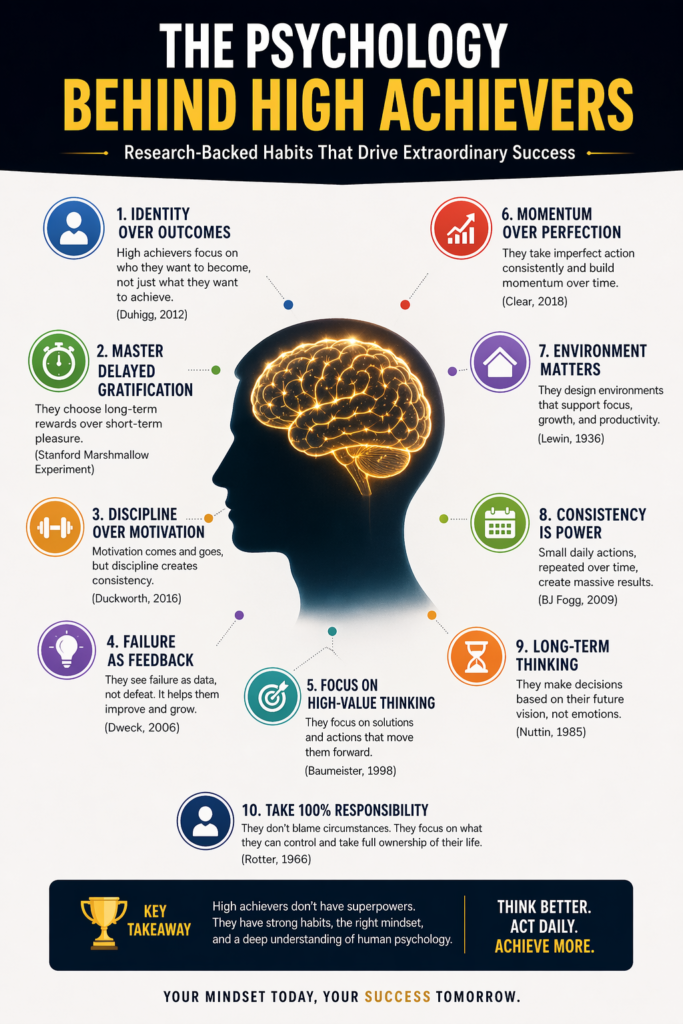
Success often looks like luck from the outside. You see someone thriving, building wealth, staying disciplined, and showing up daily. It feels effortless, almost unfair. Yet beneath that surface lies something far more structured. High achievers don’t rely on chance. They operate from a psychological framework that quietly shapes every decision they make.
This isn’t about talent alone. Research in Psychology and behavioral science consistently shows that success is driven by patterns of thinking, emotional control, and habits formed over time. Understanding those patterns can change how you approach your own goals.
Let’s break it down.
A Story That Explains Everything
A young man once struggled to stay consistent. Every morning, he promised himself he would work harder. By evening, he felt defeated. Days turned into months, and nothing changed.
Then one small shift happened.
Instead of focusing on motivation, he focused on identity. He stopped saying, “I want to succeed,” and started asking, “What would a successful person do right now?”
That question changed everything.
Within weeks, his actions began aligning with his future self. Over time, results followed. Not because he became smarter, but because he started thinking differently.
This is where psychology begins to matter.
1. High Achievers Think in Identity, Not Outcomes
Many people chase results. High achievers build identities.
Research from Behavioral Science suggests that identity-based habits are far more sustainable than goal-based actions. When behavior aligns with identity, consistency becomes natural.
For example:
- Instead of saying “I want to make money online,” they think, “I am someone who creates value daily.”
- Instead of “I need discipline,” they think, “I am disciplined.”
That subtle shift reduces internal resistance.
As a result, actions stop feeling forced. They become part of who you are.
2. They Master Delayed Gratification
One of the most famous studies in human behavior is the Stanford Marshmallow Experiment. Children who resisted immediate rewards for a bigger future reward tended to achieve more later in life.
High achievers apply this principle daily.
They choose:
- Long-term growth over short-term comfort
- Skill-building over instant entertainment
- Consistency over quick wins
This doesn’t mean they never relax. Instead, they prioritize what compounds over time.
3. They Use Discipline Over Motivation
Motivation feels powerful, but it’s unreliable.
Studies in habit formation show that relying on emotion leads to inconsistency. Discipline, on the other hand, creates predictable behavior.
High achievers understand something simple:
Motivation gets you started. Discipline keeps you going.
That’s why they build systems:
- Fixed work hours
- Daily routines
- Non-negotiable habits
Over time, these systems remove decision fatigue.
And when decisions are reduced, progress accelerates.
4. They Reframe Failure as Feedback
Failure stops most people. High achievers interpret it differently.
Research in Cognitive Psychology highlights the concept of cognitive reframing, changing how you interpret events.
Instead of thinking:
“I failed, so I’m not good enough,”
They think:
“This didn’t work. What can I adjust?”
This shift removes emotional weight from failure. It turns mistakes into data.
That’s why high achievers recover faster and improve quicker.
5. They Focus on High-Value Thinking
Not all thinking is productive.
Some people spend hours worrying, doubting, or overanalyzing. High achievers train their minds to focus on solutions.
Research shows that solution-focused thinking improves performance and reduces stress.
So instead of asking:
“Why is this so hard?”
They ask:
“What’s the next step I can take?”
This keeps momentum alive, even in difficult situations.
6. They Build Momentum, Not Perfection
Perfection is a trap.
Many people delay action because they want everything to be perfect. High achievers take imperfect action quickly.
Why?
Because momentum creates clarity.
Studies in performance psychology show that action leads to confidence, not the other way around.
Each small win builds belief. That belief fuels bigger actions.
Over time, progress becomes inevitable.
7. They Control Their Environment
Willpower is limited. Environment is powerful.
Research in Habit Formation shows that behavior is heavily influenced by surroundings.
High achievers design environments that support success:
- They remove distractions
- They keep tools easily accessible
- They surround themselves with growth oriented people
This reduces the need for constant self-control.
And when friction is low, action becomes easier.
8. They Stay Consistent (Even When It’s Boring)
Consistency doesn’t look exciting.
There are no dramatic moments. No sudden breakthroughs. Just daily effort.
Yet this is where most success is built.
High achievers understand that repetition creates mastery.
They show up:
- When they feel motivated
- When they feel tired
- When they feel nothing at all
This emotional neutrality is powerful.
Because success isn’t built on mood, it’s built on action.
9. They Think Long-Term
Short-term thinking leads to quick decisions. Long-term thinking builds lasting success.
Research in decision making shows that future oriented thinking improves outcomes in finance, health, and career.
High achievers constantly ask:
“How will this choice affect me in 1 year?”
That question filters distractions.
It also strengthens discipline.
10. They Take Responsibility for Everything
Blame is easy. Responsibility is powerful.
High achievers don’t waste time blaming circumstances, people, or luck. Instead, they focus on what they can control.
This mindset creates freedom.
Because when everything is your responsibility, everything is within your influence.
That’s where growth begins.
Bringing It All Together
The psychology behind high achievers isn’t complicated, but it is intentional.
They:
- Build identity based habits
- Choose delayed gratification
- Rely on discipline over motivation
- Reframe failure into feedback
- Focus on solutions
- Take consistent action
- Design supportive environments
- Think long-term
- Own their results
Each principle may seem simple on its own.
However, combined together, they create unstoppable momentum.
Conclusion
Success isn’t reserved for a select few. It’s built through patterns of thinking that anyone can learn.
The real difference lies in awareness.
Once you understand how high achievers think, you start noticing your own patterns. You begin catching limiting beliefs. You adjust your actions. Slowly, your identity shifts.
And when identity changes, results follow.
So here’s the question:
If you started thinking like a high achiever today, what would you do differently in the next 24 hours?